
Measuring Molecular Interactions
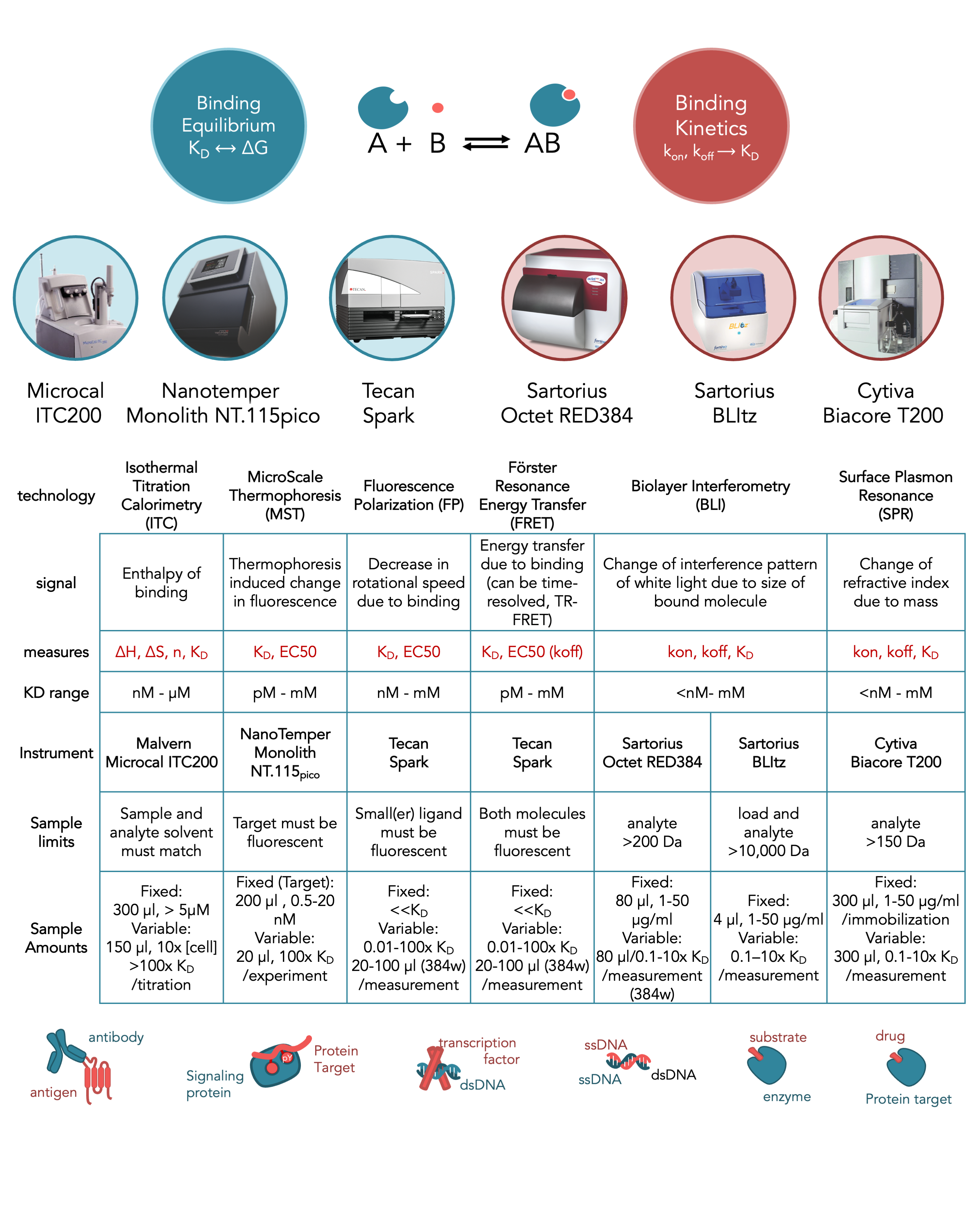
A wide array of biomolecular interactions from protein/protein interactions to small molecule ligand/compound binding interactions are important in biology. Fundamentally, there are two ways to measure (or quantify) binding of any of these interactions. You can measure some response proportional to complex formation at equilibrium and fit to a equilibrium constant, or you can measure binding kinetics by observing binding in real time and fitting the rate constants.
- Surface Plasmon Resonance (SPR) and Biolayer Interferometry (BLI) are surface-based kinetic methods, but can also be used to measure binding at equilibrium.
- Isothermal Titration Calorimetry (ITC) and MicroScale Thermophoresis (MST) are in-solution equilibrium binding methods.
- The Multimode Plate Reader can be used to perform binding assays using Fluorescence Polarization (FP), Förster Resonance Energy Transfer (FRET), Time-Resolved Förster Resonance Energy Transfer (TR-FRET) and other assays to measure binding.
- Mass Photometry (MP) can be used to detect tight binders and may provide an estimate of affinities.