
Cell-Free Protein Synthesis
CMI Nuclera resources and user guide⬇︎
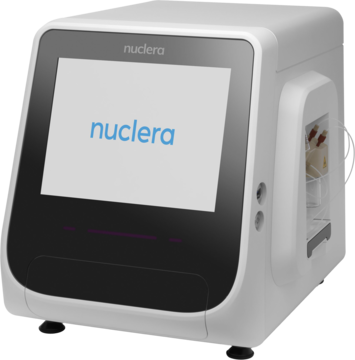
Nuclera eProtein Discovery System
The eProtein Discovery system from Nuclera is a platform for Cell-Free Protein Synthesis (CFPS), also known as in vitro transcription/translation, that enables rapid protein prototyping. The system uses a digital microfluidic chip and custom reagents to screen protein expression and solubility of up to 192 conditions, including up to 24 constructs in 8 cell-free expression conditions.
Experiments begin by designing and assembling Nuclera-compatible DNA templates, using gene blocks and Nuclera megaprimers. Each DNA construct incorporates a split-GFP peptide (GFP11) for detecting expression level, a Strep tag II for purification, and optional solubility tags. The eProtein Discovery system dispenses user-generated DNA template, cell-free core reagent and additives for gene expression onto the digital microfluidic cartridge for transcription and translation, then detection using split-GFP (green-fluorescent protein) complementation. Nuclera scale-up reagents allow expression and purification in the μg-mg/ml range, that are reproducibly predicted from the expression and purification screen yield estimates. Alternatively, selected constructs may be adapted for expression in bacteria or eukaryotic cells.
Applications
- Rapid Protein prototyping
Protein expression and purification screening
- Solubility tag screening

Key Features
- Screen and Scale-up protein production in 48 hours
- Standard workflow: 192 conditions screened
- 24 constructs in 8 cell-free conditions
- 30 purification tests
- Membrane workflow: 88 conditions screened
- 11 constructs in 8 cell-free conditions
- 88 purification tests
- Reagent kits for 200 μl to 1 ml Scale-up


Monitor data collection in real-time or review video after.
Nuclera Resources
CMI Nuclera eProtein Discovery Getting Started Guide - New!
Resources from Nuclera:
- Nuclera Quick Start Instructions:
- eGene Prep Kit Quick Start - eGene Assembly simplified instructions
- Soluble Protein Workflow Quick Start - transfer plate preparation for standard workflow (192 conditions, 30 purifications)
- Membrane Protein Workflow Quick Start - transfer plate preparation for membrane protein workflow (88 conditions, 88 purifications)
- Nuclera Knowledge Base
- Nuclera - eGene Prep Kit User Guide - eGene Assembly User Guide (full instructions)
- Nuclera - Scale-up Expression and Purification Guide - for scale-up
- Nuclera - Custom Additives - chemical compatibility - guidelines for working with custom additives
- Nuclera - Circular eGene assembly guidelines - guidelines to convert Linear eGene constructs into plasmids
Required Supplies & Equipment
Gene Assembly (at User's Lab)
- Nuclera-compatible gene fragment with 3C (5’ end) and TEV (3’ end)
- Nuclera eGene Prep kit (choose one)
- eGene Prep Kit: Solubility Tag Screen (NC3009)
- eGene Prep Kit: FlexiVariant Screen (NC3008)
- High fidelity PCR mastermix
- Platinum SuperFi II PCR MasterMix by Thermo (PN 12368010) highly recommended
- 0.2 mL thin-walled PCR tubes or 96-well PCR plate
- PCR purification kit (column- or bead-based methods, do NOT use gel extraction)
- DNA gel electrophoresis: 1% (w/v) agarose gel, DNA gel stain, Loading buffer, Electrophoresis running buffer, DNA ladder
- User-supplied equipment: Thermocycler, Electrophoresis apparatus and Gel doc
eProtein Discovery Load and Run (at CMI)
- Nuclera eProtein Discovery Cartridge (NC3006)
- Nuclera Cartridge Reagent Kit (choose one)
- Cartridge Reagent Kit (NC3010)
- Cartridge Reagent Kit: Membrane Protein (NC3013)
- 96-well Transfer plate (PCR plate or V-bottom)
- Required equipment: 30C incubator, magnetic tube rack, centrifuge (available at CMI)
Scale-up (at User’s Lab or CMI)
- Scale-up kit Strep Beads (NC3011)
- Scale-up additives (NC3005)
- DNA construct (Nuclera eGene prep kit)
- Required equipment: 29C incubator, magnetic tube rack, centrifuge
Experimental Design Tips
Gene Design
- Remove initial methionine and stop codons from the sequence(s).
- Avoid internal 3C and TEV sites.
- Codon-optimize for E.coli.
- For genes longer than 3Kb use “confidential sequence” feature to enter bp and protein mass.
Gene Assembly
- Check DNA quality by gel electrophoresis (make sure you see a single PCR product band and that the positive and negative controls look as expected)
- Purified PCR products must be eluted using eGene prep kit Elution Buffer since it contains a surfactant that is essential for downstream experimental setup
- When measuring DNA concentration using a Nanodrop
- blank with Elution Buffer (the surfactant in the buffer causes a high background absorbance)
- measure at multiple dilutions for better accuracy
Cartridge load and run
- Cartridge fluid must be degassed at 30C for at least 1 hr before run time.
- Plate setup for cartridge loading should be done right before experimental startup.
- Do not let a filled plate sit idle for more than an hour.
- Take care to avoid air bubbles during loading of the cartridge.